SF Prop H: The $129 Muni Parcel Tax on Your November Ballot
What Prop H actually is
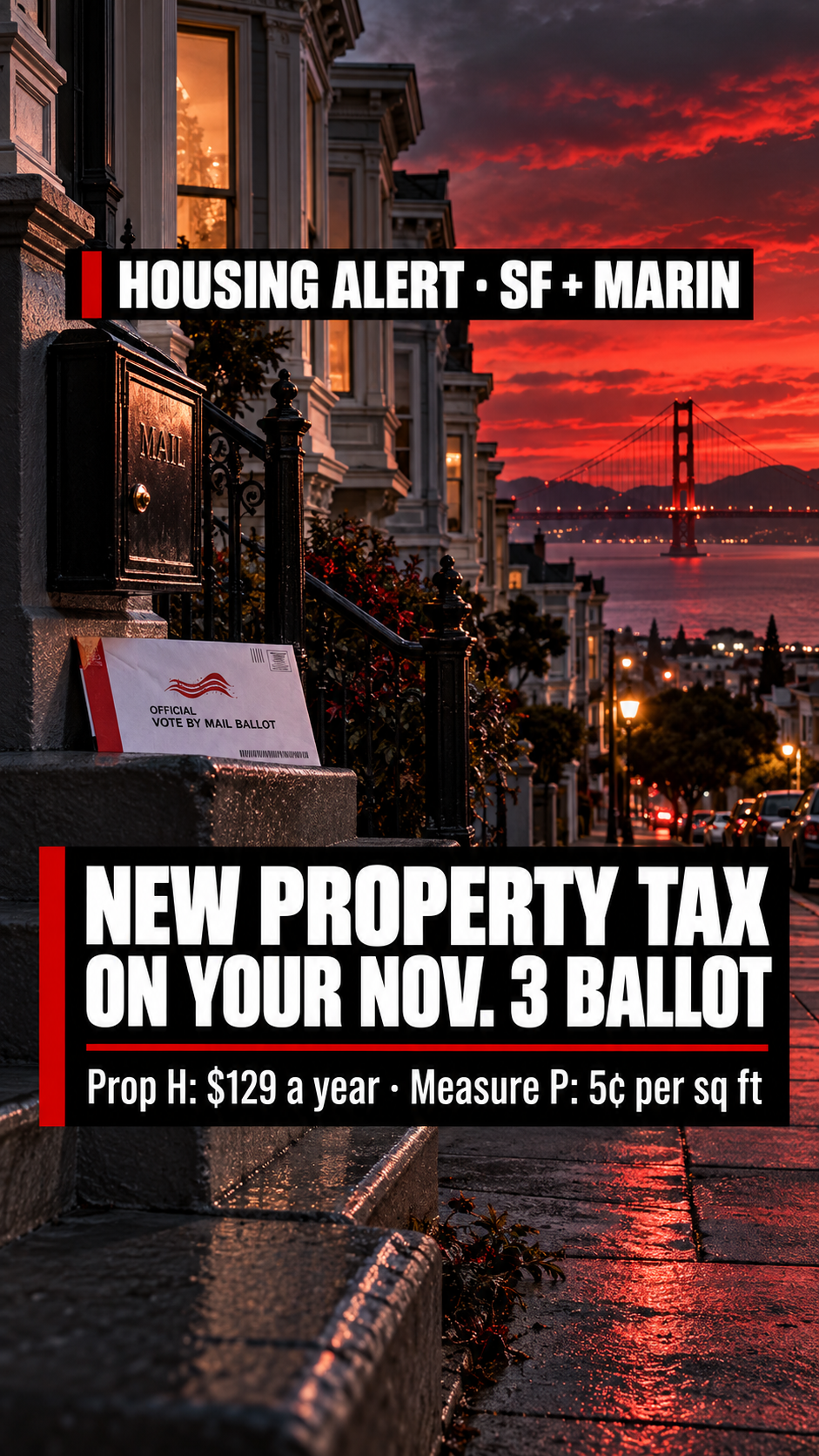
If you own a home in San Francisco, Proposition H is the measure on your Nov. 3, 2026 ballot that will show up on your property tax bill if it passes. It is a citizen initiative, qualified with 18,469 signatures, that would create a new parcel tax dedicated to Muni (GrowSF voter guide, Prop H page, read Sept. 27, 2026). It needs a simple majority to pass. I am not here to tell you how to vote, only to explain what it costs, because clients ask and because it will be a line item in escrow on every city sale for 15 years if it passes.
The tiers, with the math worked out
For single-family homes, Prop H uses three tiers based on square footage (GrowSF Prop H guide, read Sept. 27, 2026): up to 3,000 square feet, a flat $129 per year; between 3,000 and 5,000 square feet, $0.42 per square foot; above 5,000 square feet, $1.99 per square foot, with no cap.
Here is how I read those tiers, per the GrowSF guide. A 2,400 square foot home in the Sunset or Bernal Heights pays the flat $129. A 4,000 square foot home pays $129 for the first 3,000 square feet, plus $0.42 on the 1,000 square feet between 3,000 and 4,000, which is another $420, for a total of about $549 per year. The $1.99 rate applies only to square footage above 5,000, so it mostly touches the largest homes in Pacific Heights, Presidio Heights and Sea Cliff. The measure text is the final word on how the tiers stack, so confirm before you budget around it.
Other property types have their own schedules. Multifamily buildings pay $249 per year up to 5,000 square feet, then $0.195 per square foot, capped at $50,000 per year. Non-residential parcels start at a $799 base with a $400,000 cap. Empty lots pay $392 (GrowSF Prop H guide, read Sept. 27, 2026).
The senior exemption
This is the detail I get asked about most. Homeowners age 65 and older who own a single-family home pay $0 under Prop H (GrowSF Prop H guide, read Sept. 27, 2026). Note the two conditions: the owner is 65 or older, and the property is a single-family home. If you are a senior who owns a condo or a two-unit building, read the measure text or ask the city before assuming you are exempt. And if the measure passes, check whether the exemption is automatic or something you must apply for.
For families in probate, this matters in a specific way. If the parent who owned the home was 65 or older and exempt, and the home passes to an adult child under 65, the exemption goes with the parent. It is small money, but it is one more line that changes when title changes, and it belongs on the list of carrying costs the estate reviews before deciding to keep, rent or sell.
Landlords: the $65 pass-through
If you own rent-controlled units, Prop H lets you pass through a maximum of $65 per unit per year to tenants (GrowSF Prop H guide, read Sept. 27, 2026). On a small building paying the $249 base, that covers a good share of the tax. On a larger building where the $0.195 per square foot rate applies, the $65 cap means the owner absorbs most of it. If you are evaluating a rental property in the city, put it in your operating expense line; it is not a deal-changer, but it is real.
Timeline and money
Prop H would run for 15 years, from July 2027 through June 2042, and is expected to raise about $177 million per year for Muni (GrowSF Prop H guide, read Sept. 27, 2026; Local News Matters, SF Nov. 3, 2026 measures list). Because it starts in July 2027, it would not be on the tax bill for the current fiscal year. The first bills to include it would be the 2027–2028 bills, so a sale closing this fall or winter would not prorate it.
What it means when you sell
Practically, a $129 per year parcel tax is not going to change what a buyer pays for your home. Buyers in San Francisco paid over asking on 85 percent of single-family sales in August (SF Business Times, Sept. 22, 2026, citing Compass August 2026 data). A parcel tax is background noise against that. Where it shows up is in the escrow prorations, where the year's property taxes and special assessments are split between buyer and seller by closing date, and in the buyer's due diligence, where a good agent walks through each line on the tax bill. Know what the line is, know whether the senior exemption applies to the current owner, and be ready to answer in one sentence.
Ballots go out in early October, so most San Francisco voters will have theirs in the next week or two. If you want to talk through how Prop H or anything else on the ballot affects a home you own or are inheriting in San Francisco, reach out.
Sources: GrowSF voter guide, Prop H page (growsf.org), read September 27, 2026; Local News Matters, San Francisco November 3, 2026 measures list; San Francisco Business Times, September 22, 2026 (Compass August 2026 San Francisco data). This article is general information, not tax or legal advice.
Wondering what your San Francisco home is worth?
Not a Zestimate — a real valuation from a Top 1% agent with 19+ years across lending, title, and brokerage. Personal, fast, no obligation.
Get My Home Value → Text Daniel