New California Condo and HOA Laws — What Bay Area Homeowners Need to Know
In the last week of September, the governor signed a group of bills that change what a homeowners association can and cannot do in California. These five are the ones I think owners and buyers in San Francisco and Marin should know about. This is general information, not legal or tax advice, so talk to an attorney about your own building.
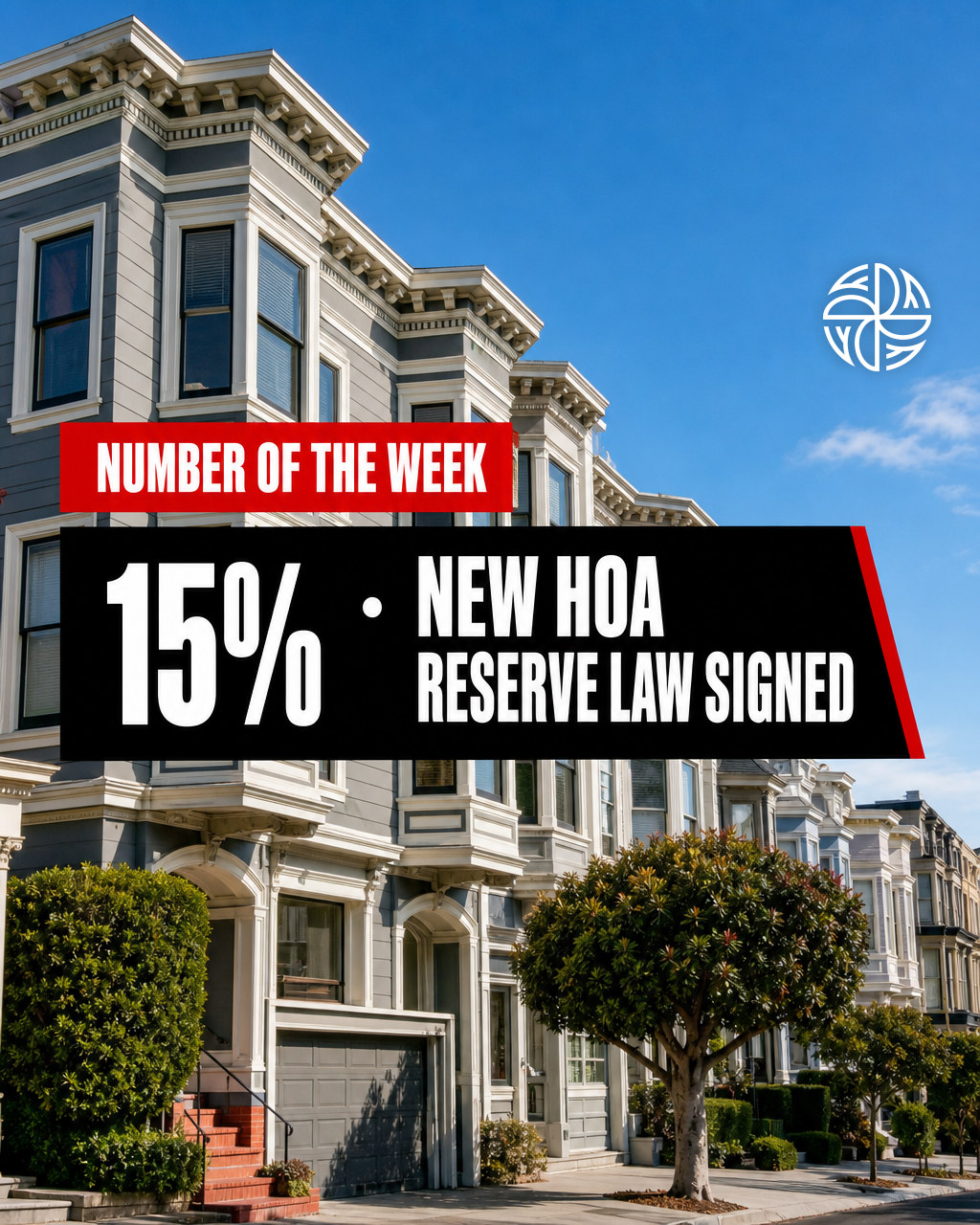
The HOA reserve law: 15 percent, starting in 2032 (AB 2050)
The biggest one is AB 2050, by Assemblymember Caloza. It was signed on September 29, 2026 and is Chapter 796 of the Statutes of 2026, according to the Governor's Office release from that day.
Here is what it does, according to the CalMatters Digital Democracy page for the bill. Beginning January 1, 2032, an HOA reserve study must state the minimum reserve contribution needed to keep the projected reserve balance from falling below zero over the following 30 years, and the association must fund at that level each year.
If the reserves are projected to fall below zero within 30 years, the association must transfer a minimum of 15 percent of its gross annual budget to its reserve account each year. If the regular budget cannot cover that, the HOA must levy a reserve funding special assessment, and it can do that no more often than once every nine years.
CBS San Francisco reported on September 23, 2026 that about 14 million Californians live in HOAs. In that same report, opponents predicted higher dues and supporters said the law will mean fewer surprise assessments. I think both sides can be right.
The date is 2032, but I would not wait for it. I expect careful buyers to start asking about reserves well before the deadline.
Your HOA can no longer block new windows (SB 908)
SB 908, by Senator Wiener, was also signed on September 29, 2026 and takes effect January 1, 2027 (Governor's Office, Sept. 29, 2026). It adds Civil Code section 4754.
According to the FindHOALaw summary of SB 908, the law voids any HOA covenant that effectively prohibits or restricts a residential window replacement project. The association must approve the project if the owner agrees in writing to follow the governing documents, use a licensed contractor, pull permits and pay the costs.
An HOA can still set reasonable restrictions, but only if they do not significantly raise the cost or cut the efficiency of the new windows. The board loses the ability to simply say no.
Air conditioning and heat pumps (AB 1684)
AB 1684, by Assemblymember Ward, is Chapter 887 and was chaptered on September 30, 2026 (Governor's legislative update, Sept. 30, 2026).
Per the CalMatters Digital Democracy page for the bill, it voids governing document provisions that prohibit or restrict the installation, upgrade, replacement or use of a cooling system that meets code. That includes portable and window air conditioners and heat pumps.
The law has a penalty. For a willful violation, an association can owe actual damages plus a civil penalty of up to $2,000 and attorney fees. The source I read does not state the effective date, so confirm that before you order equipment.
Two ADUs per lot and lower fees (AB 956, SB 1117)
Two more bills deal with accessory dwelling units, and they matter most to owners of single-family homes.
AB 956, by Assemblymember Quirk-Silva, is Chapter 791 and dated September 29, 2026 (CalMatters Digital Democracy). It raises the number of detached new-construction ADUs a city must approve ministerially on a single-family lot from one to two. It also voids restrictive covenants that prohibit or unreasonably restrict ADUs. The law firm Allen Matkins wrote on October 4, 2026 that it takes effect January 1, 2027.
SB 1117, by Senator Cervantes, is Chapter 809, also dated September 29, 2026. Per CalMatters Digital Democracy, fees for certain ADUs must be based only on the area in excess of 750 square feet of interior livable space.
As a real estate investor myself, I see a second detached unit as a real change in what a lot can do. Whether it works on your lot is a question for your city's planning department.
What this means if you are buying or selling a condo in San Francisco or Marin
If you are buying, read the reserve study before you fall in love with the view. Look at the projected balance, then ask what the board plans to do about any shortfall. That applies whether the building is in the city or in Marin County.
If you are selling, know your building's numbers before a buyer asks. A thin reserve is better explained up front than discovered in escrow.
If you would like to know what your condo or home is worth today, reach out and I will send you a free home value report. I can also send you this week's list of homes that are not on the portals yet.
Sources: Governor's Office release on signed legislation, Sept. 29, 2026; Governor's legislative update, Sept. 30, 2026; CalMatters Digital Democracy, AB 2050, AB 1684, AB 956 and SB 1117 (2026); CBS San Francisco, report on AB 2050, Sept. 23, 2026; FindHOALaw, summary of SB 908; Allen Matkins, AB 956 alert, Oct. 4, 2026. This article is general information, not tax or legal advice.
Wondering what your condo or home is worth?
Not a Zestimate — a real valuation from a Top 1% agent with 19+ years across lending, title, and brokerage. Personal, fast, no obligation.
Get My Home Value → Text Daniel